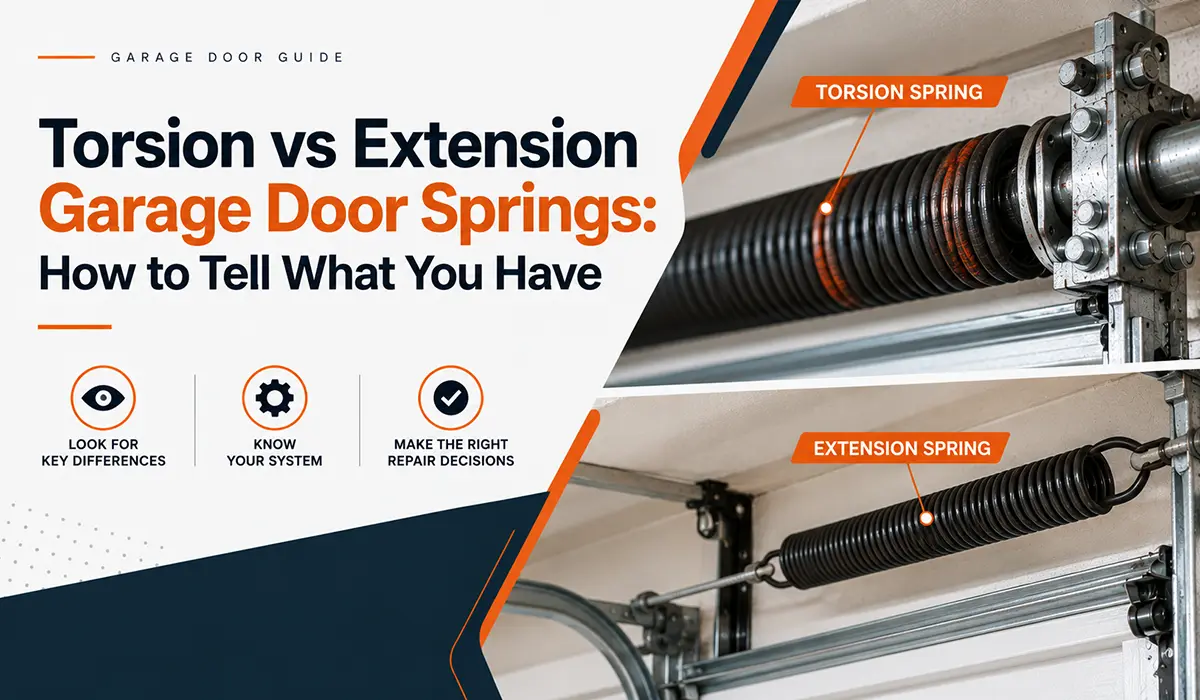

The fastest way to tell which springs you have is to look at where they sit. If there is a spring or two wound around a metal shaft mounted horizontally on the wall directly above the closed door, you have torsion springs. If instead you see a long spring running along each side above the horizontal tracks, stretched out parallel to the ceiling, you have extension springs. That one glance answers it for most homeowners.
Knowing which type you have matters more than it sounds. It changes what a replacement costs, how the door balances, how long the spring lasts, and how the repair is done. This guide shows you exactly how to identify your springs, explains how the two types differ, and covers the one rule that applies to both: spring work is not a do it yourself job.
The 30 second identification test
Open your garage so the door is closed, stand inside, and look at the area above the door.
Look for a horizontal metal bar (the torsion shaft) running along the wall just above the top of the door, with one or two tight springs coiled around it. That is a torsion setup. The springs are usually black and sit close together in the middle or split to either side of a centre bracket.
Now look at the two horizontal tracks that run back from the door toward the rear of the garage. If you see a long spring stretched along each track, above and parallel to it, one on the left and one on the right, that is an extension setup. These springs visibly lengthen when the door closes and shorten when it opens.
Most homes have one or the other. If you are still not sure after looking, take a photo from a safe distance and a technician can identify it in seconds.
What a torsion spring is
A torsion spring stores energy by twisting. It sits on the shaft above the door, and when the door lowers, the spring winds up tight and holds that tension. When you open the door, the spring unwinds and its stored energy does the heavy lifting, so the opener only has to guide the door rather than carry its full weight.
Torsion springs are the more modern and more common choice on today’s doors. A standard single door usually runs one torsion spring, while heavier or double doors often use two. They give smoother, more balanced movement, and because the spring is captured on the shaft, a break is far more contained than with an extension spring.
The trade off is cost. Torsion springs cost more up front, but they typically last longer and control the door better, which is why most technicians recommend them.
What an extension spring is
An extension spring stores energy by stretching. Mounted along the upper tracks on both sides, these springs extend when the door closes and contract when it opens, pulling the door up as they retract. They almost always come in pairs, one on each side, so the load is shared evenly.
Extension springs are common on older doors and lighter single doors. They cost less, which is part of why they were the standard for years. The downside is that they are under a lot of tension while stretched, and when one snaps it can whip loose with force. That is why every extension spring system needs a safety cable running through it, a thick cable that catches the broken spring and stops it from flying across the garage. If you have extension springs and there is no safety cable threaded through them, that is a hazard worth fixing right away.
Torsion vs extension at a glance
| Feature | Torsion springs | Extension springs |
|---|---|---|
| Where they sit | On a shaft above the door | Along the tracks on each side |
| How they work | Twist to store energy | Stretch to store energy |
| Number of springs | One or two | Two, one per side |
| Door balance | Smoother, more controlled | Slightly less balanced |
| Lifespan | Longer, more cycles | Shorter |
| When it breaks | Contained on the shaft | Can whip loose without a safety cable |
| Cost | Higher up front | Lower up front |
| Best for | Most doors, heavier and double doors | Older and lighter single doors |
How to tell what you have, step by step
If you want to be certain, walk through these quick visual checks. You are only looking, not touching.
Stand inside with the door closed. First, check the wall directly above the door. A horizontal bar with coiled springs on it means torsion. Second, check the ceiling area above the side tracks. Long springs running front to back along each track mean extension. Third, count them. A single spring in the centre almost always means torsion, while a matched pair on the left and right almost always means extension.
Still unsure? Watch the springs as someone else operates the door from a safe distance. Torsion springs rotate on the shaft. Extension springs visibly stretch and contract. That movement is the clearest tell of all.
Which type is better, and why it matters for your door
For most Edmonton homes, torsion springs are the better long term choice. They balance the door more evenly, put less strain on the opener, last more cycles, and fail more safely. If your door currently uses extension springs and you are replacing them anyway, it is worth asking whether a torsion conversion makes sense for your setup.
That said, the right answer depends on your door’s weight, the headroom above the opening, and your budget. A heavier or double door really benefits from torsion. A lighter single door with proper safety cables can run well on extension springs. This is the kind of thing an honest inspection sorts out quickly. Learn more about garage door repair in Edmonton and how the right parts keep your door running for years.
The one rule for both types: never replace a spring yourself
This is the part that matters most. Both torsion and extension springs hold the full weight of the door under intense tension. A spring that lets go without warning, or a wrench that slips during winding, can cause serious injury. Every year homeowners are hurt trying to save money on a spring they should have left alone.
Replacing a spring safely means releasing and re-tensioning parts under load with the correct winding bars and tools, matching the spring to the exact weight and size of the door, and testing the balance afterward. It is precise work, and getting the tension wrong leaves the door dangerous even if it looks fine. This is why spring replacement belongs with a trained technician. If you need it done, book a broken garage door spring replacement in Edmonton.
How to tell your spring is failing
You do not always get a warning, but there are signs worth watching for with either type. The door feels heavy or will not open, even though the opener runs. You heard a loud bang from the garage, which is the classic sound of a spring snapping. You can see a visible gap in a coil that should be tight. The door opens partway then stops, or hangs crooked. Or the door slams down faster than it should.
If you notice any of these, stop running the opener. Forcing a door with a failing spring strains the motor and can pull the cables out of place too, turning one repair into two. Cables and springs often fail together, so if a cable has also gone, you will want garage door cable repair at the same time.
Why springs break sooner in Edmonton
Cold is hard on springs. Steel gets more brittle as the temperature drops, which is why so many springs break on the first hard frost and again in the deep cold of January. Every open and close is one cycle, and a spring is rated for a set number of cycles before it wears out. Big households that run the door many times a day burn through those cycles faster, and freeze and thaw swings add extra stress.
You cannot make a spring last forever, but a yearly tune up helps. During garage door maintenance, a technician checks the spring tension, lubricates with cold rated product so the spring is not fighting stiff grease, and spots wear before the spring fails at the worst possible moment. A fall service visit is the cheapest insurance against a stuck door on a minus thirty morning.
When to call Fix in Budget
Whether you have torsion or extension springs, replacement is a technician job, and a same day one when the door is stuck. Fix in Budget Garage Door Services handles spring replacement, cable repair, and full tune ups across Edmonton and surrounding areas, backed by a fixed right or it is free guarantee.
Not sure which springs you have? Send a photo or describe what you see, call 780-908-0907, or request a free quote, and we will bring the right parts the first time.
Frequently asked questions
How do I know if I have torsion or extension springs?
Look above your closed garage door from inside. If there is a spring wound around a horizontal metal shaft mounted on the wall above the door, you have torsion springs. If there are long springs running along each side track parallel to the ceiling, you have extension springs. Torsion springs twist, extension springs stretch.
Which is better, torsion or extension springs?
Torsion springs are usually the better choice for most doors. They balance the door more evenly, last more cycles, put less strain on the opener, and fail more safely because the spring is captured on the shaft. Extension springs cost less and work fine on lighter doors, as long as safety cables are installed.
Can I replace a garage door spring myself?
No. Both torsion and extension springs are under high tension and hold the full weight of the door. A slip or a sudden release can cause serious injury. Spring replacement needs the correct winding tools, a spring matched to the door’s exact weight, and a proper balance test afterward, so it should always be done by a trained technician.
Why do garage door springs break in the cold?
Steel becomes more brittle in cold weather, so springs are more likely to snap on the first hard frost and during the deepest winter cold. Each open and close also counts as one cycle toward the spring’s rated life. A yearly fall tune up with cold rated lubricant helps the spring work less hard and catches wear early.
How long do garage door springs last?
Most springs are rated for roughly ten thousand cycles, and torsion springs often last longer than extension springs. How many years that works out to depends on how often you use the door. A busy household that opens and closes the door many times a day will wear springs out faster than one that uses it a few times a day.
