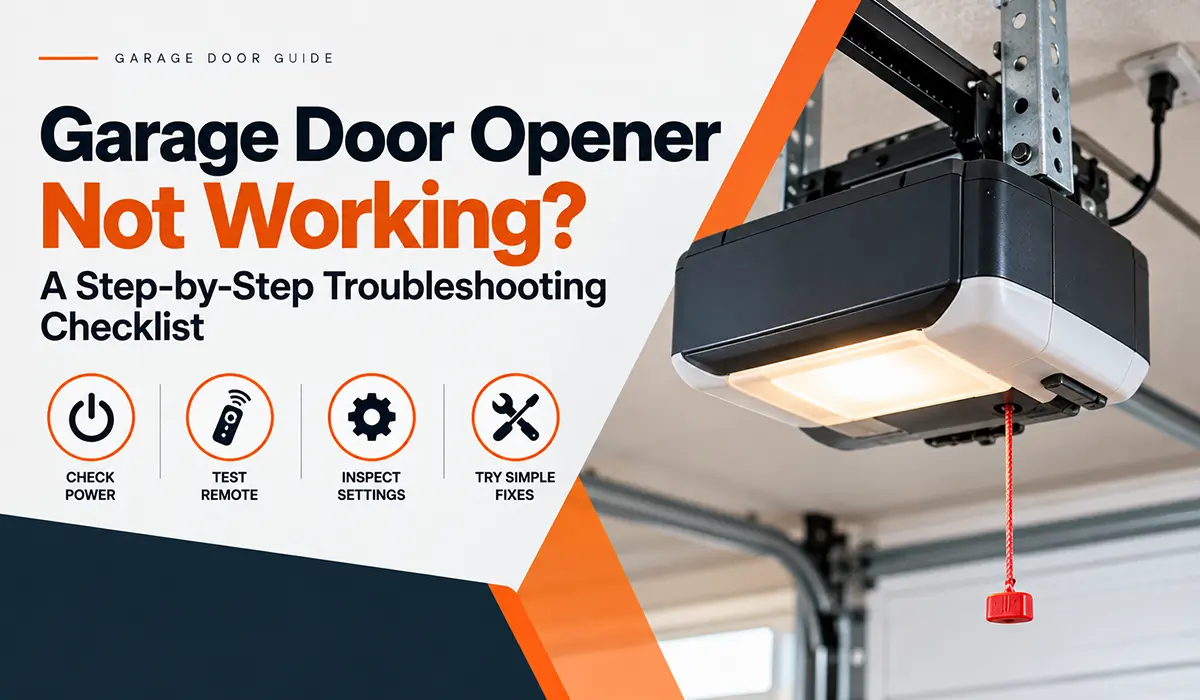

If your garage door opener is not working, check these in order: power at the outlet and breaker, the remote batteries, the lock button on the wall control, the safety sensors, anything blocking the door, and the emergency release cord. If the motor runs but the door does not move, or the door feels very heavy by hand, the cause is likely a worn gear, a disconnected trolley, or a broken spring. Stop there and call a professional.
You press the remote and nothing happens. You are late, it is minus 20, and your car is stuck inside.
Most opener problems have simple causes. Dead batteries, a tripped breaker, and a dirty sensor fix a large share of “broken” openers in a few minutes. Others are signs of a bigger issue, like a failed spring, and those need a technician.
This checklist goes from the easiest fix to the hardest, so you do not waste time or take a risk you do not need to. If you want a wider look at every kind of door problem, see our garage door not working troubleshooting guide. This guide focuses on the opener itself.
Before you start: 4 safety rules
- Never stand or reach under a door that is moving or partly open. Keep kids and pets away.
- Do not put your fingers in the tracks, rollers, or hinges. They can pinch hard.
- Do not touch the springs, cables, or brackets above and beside the door. If you heard a loud bang before the door stopped working, skip to Step 9 and read the warning.
- Do not open the opener motor housing while it is plugged in. Parts inside can hold a charge even when the unit is idle.
You will need new batteries, a soft cloth, a flashlight, your opener manual (or the model number so you can look it up), and a stable step ladder if your outlet is on the ceiling.
Step 1: Notice exactly what the opener is doing
Before you change anything, watch and listen. What the opener does tells you where to look. Use this table to jump to the right step.
| What you see or hear | Most likely cause | Go to |
|---|---|---|
| No light, no sound, nothing | No power, tripped breaker or GFCI | Step 2 |
| Wall button works, remote does not | Remote battery or programming | Step 4 |
| Neither works, light is on | Lock mode, sensors, or a stuck door | Steps 5 to 7 |
| Door starts to close, then reverses | Sensors, obstruction, or force setting | Steps 6, 7, 10 |
| Opener light blinks and door will not close | Sensor problem | Step 6 |
| Motor runs but door does not move | Disconnected trolley or stripped gear | Step 8 |
| Humming but no movement | Door too heavy, often a broken spring | Step 9, call a pro |
| Grinding or clicking, no movement | Worn gear or damaged drive | Call a pro |
| Door lifts a few inches then stops | Broken spring or off track | Step 9, call a pro |
Step 2: Check the power
It sounds basic, and it is the most common fix. Check these in order:
- Is the opener plugged in? Cords get knocked loose by storage bins and ladders.
- Does the outlet work? Plug in a lamp or phone charger to test it.
- Reset the GFCI outlet if there is one. Garage outlets often have them, and they trip in cold or damp weather.
- Check your breaker panel for a tripped breaker.
If the opener still has no light and no sound with good power, the circuit board may have failed. Power surges and lightning can cause this. That is a job for a technician. See our garage door opener service.
Step 3: Test the wall button and the remote separately
Press the wall button. Then press the remote from inside the garage.
- Wall button works, remote does not: the opener is fine. Go to Step 4.
- Remote works up close but not from the driveway: check the batteries and the opener antenna (Step 4).
- Neither works: keep going. The cause is the opener, the sensors, or the door.
Step 4: Fix the remote
Replace the battery first. Check the battery type printed inside the remote, since many use a coin cell. Test any other remotes and the keypad too.
If a new battery does not help:
- Move closer to the door and try again. Weak signal is often a battery or antenna problem.
- Check the antenna wire hanging from the opener. Make sure it is not tucked behind metal or damaged.
- Reprogram the remote using the “learn” button on the opener. Steps differ by brand, so follow your manual.
- Look for new sources of interference, such as LED bulbs or new electronics near the opener. If range dropped after you changed a bulb, that may be why.
If you have a car remote or a keypad that stopped working at the same time, the opener may need a signal reset or repair.
Step 5: Check for lock or vacation mode
Many wall controls have a lock button. When it is on, the opener ignores remotes but still responds to the wall button. Someone may have pressed it by accident. Check the wall control for a blinking light, then press and hold the lock button for a few seconds. Your manual will confirm how it works on your model.
Step 6: Clean and align the safety sensors
Safety sensors are the two small eyes on either side of the door, a few inches above the floor. They send an invisible beam across the opening. If something breaks the beam, or the sensors are not pointing at each other, the door will not close.
A classic sign is an opener light that flashes when you press the button while the door refuses to close. Here is what to do:
- Look at the indicator light on each sensor. Both should glow steady. A blinking or dark light means a problem.
- Wipe each lens with a soft, dry cloth. Dust, frost, and cobwebs are common culprits.
- Check that nothing is in the beam, such as a bin, a bag, or a bike wheel.
- See if a bracket was bumped. Loosen the wing nut slightly, gently turn the sensor until the light goes steady, and tighten it again.
- Check the thin wires on each sensor for cuts or chew marks. If the wires are damaged, stop and call us.
In winter, snow and frost on the sensors can block the beam. Low sun at certain times of day can also confuse some sensors. For more detail, see our guide to fixing a garage door sensor.
One important note. If the sensors keep failing no matter what you do, do not try to bypass them. They protect people and pets from a closing door.
Step 7: Clear the door path and check the tracks
A door that meets resistance will stop or reverse. Look for items in the path, and check the tracks and rollers with a flashlight.
- Remove anything on the floor under the door.
- Look for packed snow, ice, or debris at the bottom of the tracks.
- Look for a bent track, a track that has pulled away from the wall, or a roller that has popped out.
If a roller or track looks damaged, do not force the door. Read our guide on a garage door off track and our post on roller and hinge failure, or book garage door roller replacement.
Step 8: Check the emergency release and the trolley
The red cord that hangs from the opener rail is the emergency release. It disconnects the door from the opener so you can move the door by hand. If someone pulled it, or the cord got snagged, the motor can run while the door does not move.
- Look at the trolley on the rail. Is it separated from the carriage that connects to the door?
- Reconnect it using your opener manual. On many models, the trolley re-latches the next time the opener runs, but this varies, so check yours.
- If the chain or belt is slack, broken, or has fallen off, stop. Do not run the opener.
If the motor runs and you hear grinding, but the door stays put, a gear inside the opener may be stripped. That needs a professional repair or a new opener.
Step 9: Check the door balance (with care)
The opener is built to guide a balanced door. The springs do the heavy lifting. If a spring breaks, the door becomes very heavy, and the opener may hum, strain, or lift the door only a few inches.
Warning
If you heard a loud bang before the door stopped working, or you can see a gap in a spring above the door, do not test the balance. Do not try to lift the door. Keep clear and call a professional.
If you did not hear a bang, close the door and use the emergency release to disconnect the opener. Gently lift the bottom edge a few inches. A balanced door feels fairly light and moves smoothly. If it feels like dead weight, or it will not stay where you leave it, stop and lower it.
A heavy door usually means a spring problem. Read our guide on the signs of a broken torsion spring and see why you should never replace a garage door spring yourself. Running the opener against a heavy door can burn out the motor, so leave it off and call us.
Step 10: Reset the opener and check the limit settings
A short reset can clear a glitch. Unplug the opener for about a minute, plug it back in, and test the door.
If the door stops short of the floor, reverses at the floor, or does not open all the way, the limit or force settings may have drifted. These are usually small adjustment screws or buttons on the opener. Follow your manual, change one setting at a time, and make tiny changes.
A word of caution. Do not turn the force setting up to make the door push through a sensor problem or a stuck spot. That can defeat the safety reversal and make the door unsafe. If you are not sure, call us.
Many openers also flash a number of times on the motor light to show a fault code. The meaning depends on the brand, so check your manual or the label on the unit.
When to stop and call a professional
Stop the checklist and call a technician if you see any of these:
- The door feels very heavy or lifts only a few inches
- You heard a bang, or a spring looks broken or stretched
- A cable is frayed, slack, or off the drum. See our guide to a snapped garage door cable
- The motor runs, but the door does not move, and the trolley is connected
- Grinding, burning smells, or smoke from the opener
- Damaged or exposed wiring
- Sensors keep failing after you clean and align them
- The door is crooked, off track, or the tracks are bent
We can help the same day. See our same day garage door repair and 24/7 emergency garage door repair. If your car is stuck inside, read what to do when your car is trapped in the garage.
Need to get the door open in the meantime? Our guide on how to open a garage door manually explains it. Please read the warnings first, especially if the spring may be broken.
How a professional diagnoses an opener problem
A good technician does not just replace the opener. They work through the whole system:
- Test power and the circuit board
- Check the remote, keypad, and wall control
- Test the safety sensors and the auto reverse
- Inspect the drive (chain, belt, gears, and trolley)
- Check the door balance, springs, cables, rollers, and tracks
- Give you a clear price before they start the repair
That last check matters most. A lot of “opener problems” are really door problems. If the springs or cables are worn, a new opener will not fix anything and may fail early. We look at the whole system so you only pay for what the door needs. Our full list of garage door services includes opener repair and installation, spring replacement, cable repair, and general repair.
Repair or replace the opener?
Openers often last around 10 to 15 years, depending on use and care. Repair usually makes sense for a newer unit with a single failed part, like a circuit board, a gear set, or a remote receiver.
Replacement is worth thinking about when:
- The opener is more than 10 to 15 years old
- Repairs are getting more frequent
- It is very loud or shakes the door
- Parts are hard to find
- You want newer security and safety features, such as rolling code and stronger sensors
A newer opener also helps home security, since old units can be easier to copy. Read why garage door maintenance is critical for home security. If you are leaning toward a new unit, see our garage door opener installation or a full garage door installation if the door itself is tired. Our guide to when to replace instead of repair helps with that call. For businesses, we also handle commercial overhead door openers.
How to prevent opener problems
- Replace remote batteries once a year. Do it at the same time each fall.
- Test the auto reverse monthly. Lay a flat board on the floor in the door path and close the door. It should reverse when it touches the board. If it does not, stop using the opener and call us.
- Keep sensors clean. Wipe them when you clean the garage.
- Lubricate as directed. Use the right product for each part, and check your manual before lubricating the opener chain or belt.
- Book a yearly tune up. Our garage door maintenance visit checks the opener, the springs, the cables, and the safety features. A fall visit before the deep cold is the best time.
- Watch for early warning signs. See our list of 10 signs your garage door needs immediate repair and common garage door problems in Edmonton.
Cold and moisture are hard on every part. Our post on protecting your garage door from rust and moisture damage has more tips for Edmonton winters.
Opener repair across the Edmonton area
We repair and install openers in Edmonton, St. Albert, Sherwood Park, Spruce Grove, Leduc, Beaumont, Nisku, and Fort Saskatchewan. We work with common brands, including LiftMaster, Chamberlain, and Genie. For a deeper look at fixing a broken unit, see how to fix a broken garage door opener.
Frequently asked questions
Why is my garage door opener not working but the light is on?
A lit opener has power, so the problem is usually elsewhere. Common causes are the wall control lock mode, misaligned or blocked safety sensors, a disconnected trolley, or a door that is too heavy because of a broken spring. Work through Steps 5 to 9 of this checklist in order.
Why does my garage door opener hum but not move the door?
A hum means the motor is getting power but cannot move the load. The most common reason is a broken spring, which makes the door very heavy. It can also be a worn motor part or a jammed door. Turn the opener off and call a technician rather than letting it keep straining.
Why does my garage door close and then go back up?
The opener is reversing for safety. The usual causes are dirty or misaligned sensors, something in the door path, or a limit or force setting that has drifted. Clean and align the sensors first, then check for obstructions. Do not turn up the force setting to push past the problem.
Why does the wall button work but not the remote?
That points to the remote, not the opener. Replace the battery, move closer, and try reprogramming the remote with the learn button. Check the opener antenna too. If other remotes also fail, the opener receiver may need repair.
What does a blinking light on my garage door opener mean?
It depends on the brand. A blinking light often points to a sensor problem or a stored fault code. Check the sensors first, then look at your manual or the label on the opener to match the number of flashes to the fault.
Can I open my garage door by hand if the opener is not working?
Yes, in most cases, by pulling the emergency release cord. Do not do this if you suspect a broken spring, because the door can be very heavy or fall. Read our guide on how to open a garage door manually first.
How much does it cost to fix a garage door opener in Edmonton?
The cost depends on the problem. A new remote or sensor realignment costs far less than a new circuit board, gear set, or full replacement. We give a clear quote before work begins. For general repair pricing, see how much it costs to fix a garage door in Edmonton or request a free quote.
Still not working? We can help today
Most opener problems can be fixed with a few minutes of checking. When the cause is a spring, a cable, a gear, or a circuit board, the safest and fastest fix is a technician.
Fix in Budget Garage Door Services offers free quotes, same day service, and a Fixed Right or It’s Free guarantee across Edmonton and nearby cities.
Door still stuck? Call 780-908-0907, request a free quote, or book an appointment online. You can also browse more tips on our garage door blog.
