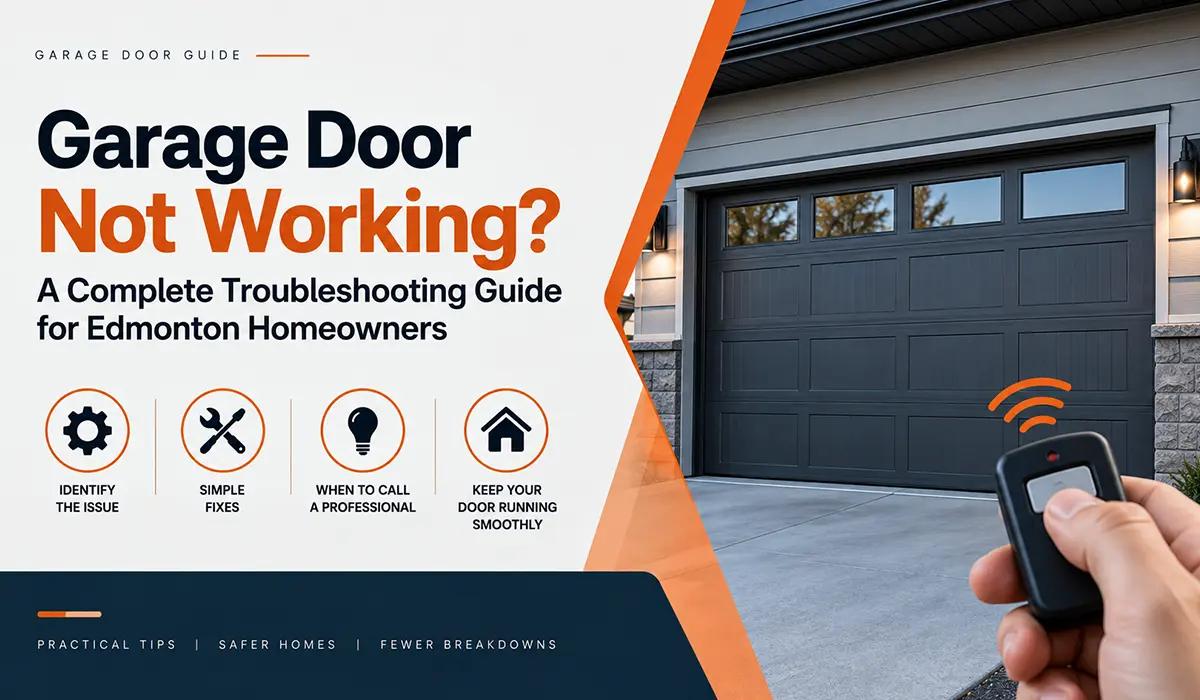

When your garage door stops working, the cause is almost always one of six things: a broken spring, a snapped cable, a dead opener, worn rollers, a door off its track, or a system stiffened by Edmonton’s cold. This guide walks you through each symptom, tells you the likely cause, shows you a safe check you can do in a minute, and points you to the fix. Some of these you can sort out yourself in a few minutes. A few are dangerous to touch and need a trained technician, and we will be clear about which is which.
Before you touch anything: a 30 second safety check
A garage door is the heaviest moving object in most homes, and parts of it are under enough tension to cause serious injury. Two components deserve real respect: the springs and the cables.
The springs sit above the door or along the sides and hold the entire weight of the door. When one breaks, it releases a large amount of stored energy in a fraction of a second. The cables run under similar tension. Never try to adjust, loosen, or replace a spring or cable yourself. This is the single most common way homeowners get hurt working on a garage door.
The safe checks below stay away from those parts. If a fix involves the spring or cable, treat that as a call to a professional, not a weekend project.
One more thing before you start: if your door is stuck partway open and you need to leave, do not force it. A door that is off balance can drop. Pull the red emergency release cord to disconnect the opener, then support the door and lower it by hand only if it feels balanced and light. If it feels heavy or jams, leave it and call for help.
Garage door will not open at all
If the door does not move when you press the remote or wall button, start by ruling out the opener before you assume the worst. Check that the opener has power, the wall button works, and the door is not locked. Then look at the door itself while it is closed.
Here are the usual causes, from most to least common:
A broken spring. This is the top reason a door refuses to open. If you heard a loud bang from the garage recently, like a firecracker or a snap, a spring almost certainly broke. Look at the spring above the door. If you see a visible gap where the coil has separated, that is your answer. The opener may hum and strain but the door will not lift, because the motor cannot carry the full weight of the door on its own. This is not a DIY fix. A trained technician needs to replace it safely. Book a broken garage door spring replacement in Edmonton and do not run the opener again until it is done, or you risk burning out the motor.
A snapped cable. The lifting cables can fray or break, often at the same time as a spring or from rust and age. A broken cable usually leaves the door crooked or stuck on one side. Because the cable works alongside the spring under tension, this is also a job for a technician. See garage door cable repair in Edmonton.
A dead opener. If the door is not locked and the springs and cables look intact but nothing happens when you press the button, the opener itself may be the problem. We cover opener faults in detail further down.
The door is locked or the disconnect is pulled. It sounds obvious, but a manually engaged lock or a pulled emergency release cord will stop the opener from moving the door. Check both before calling anyone.
Garage door will not close, or reverses before it hits the ground
A door that opens fine but refuses to stay closed is almost always a sensor or opener issue, not a spring or cable problem. The good news is that this one is often a two minute fix.
Every modern opener has two small photo eye sensors near the bottom of the tracks, roughly six inches off the floor. They shine an invisible beam across the opening. If anything breaks that beam, or if the sensors are dirty, knocked out of alignment, or unplugged, the opener refuses to close as a safety measure and reverses the door.
Do this quick check. Look at the two sensors. Most have a small light. If one light is off or blinking while the other is steady, they are misaligned. Wipe both lenses gently with a soft cloth, since dust, cobwebs, and road salt film build up over an Edmonton winter. Then check that nothing is sitting in the beam, like a garbage bin, a garden hose, or a snow shovel. Gently nudge the sensors so they point straight at each other until both lights hold steady.
If the sensors are clean, aligned, and clear, and the door still will not close, the fault is likely in the opener’s logic board, limit settings, or wiring. That points to garage door opener repair in Edmonton.
Garage door is loud, grinding, squealing, or rattling
Noise is your door telling you something is wearing out. The type of sound narrows down the cause.
Squealing or squeaking usually means the moving parts are dry. Rollers, hinges, and the track need lubrication, especially after Edmonton’s dry, cold months strip the grease away. A proper tune up with the right lubricant, not WD-40, quiets most squeaks. This is part of routine garage door maintenance.
Grinding or scraping points to the rollers. Old steel rollers wear flat, and worn bearings drag along the track instead of rolling smoothly. Look at a few rollers as the door moves. If they wobble, sit crooked, or the wheel is chewed up, it is time for garage door roller replacement. Fresh nylon rollers run noticeably quieter.
Rattling or banging often means loose hardware. Doors vibrate thousands of times a year and bolts work themselves loose. Hinges, brackets, and track fasteners can all loosen over time. A technician can tighten and inspect the whole system during a maintenance visit.
A single loud pop or bang, as mentioned earlier, is the sound of a spring breaking. That is not a lubrication issue. Stop using the door and book a spring replacement.
Do not ignore new noises. A door that grinds today is a door that jams or comes off its track next month. Catching it early keeps a cheap tune up from turning into a bigger repair.
Garage door is off track or crooked
A door that hangs at an angle, sits unevenly, or has jumped out of the metal track is unsafe to operate. Stop pressing the button. Running an off track door can bend panels, damage the opener, and drop the door.
Common causes include a broken cable, worn or broken rollers that let the door slip out of the track, a bent track from being bumped by a vehicle, or an obstruction that knocked the door out of alignment.
Here is the safe check: look, do not touch. See if you can spot a snapped cable hanging loose, a roller that has popped out of the track, or a visibly bent section of rail. Note what you see so you can describe it, then leave the door where it is.
Getting a door back on its track safely means releasing and re-tensioning parts that are under load, which is why this is a technician job. Depending on the cause, the fix falls under garage door cable repair, roller replacement, or a broader garage door repair in Edmonton if the track and panels need attention. A same day visit gets your door back in service before the crooked panel bends further.
Garage door is slow, stiff, or struggles to open in the cold
This is the Edmonton special. When the temperature drops below freezing, a door that worked fine in September starts moving slowly, groaning, or stopping partway. Cold weather is hard on garage doors for a few reasons, and most of them are fixable.
Grease thickens in the cold. The lubricant on your rollers, hinges, and springs stiffens up, so the whole system fights the opener. Metal contracts, tightening tolerances. And the rubber weather seal along the bottom can freeze to the concrete, so the door feels stuck when it is really just iced down.
Try this first. If the door seems frozen to the floor, do not force it with the opener, since that strains the motor and can pull the bottom bracket loose. Free the seal by hand or with a bit of warm water, then clear the ice from the threshold.
If the door still labours, the issue is usually old lubricant and worn parts. A winter tune up with cold rated lubricant makes a real difference. This is one of the most useful things Edmonton homeowners can do before the deep cold sets in, and it is covered under garage door maintenance.
One caution: springs get more brittle in the cold, which is why so many break on the first hard frost of the season. If your door suddenly refuses to open on a cold morning and you hear straining, do not keep hitting the button. Have the spring checked.
Garage door opener is dead, or the remote will not work
When the door itself looks fine but nothing responds, work through the opener from simplest to most involved. Most of these you can check yourself.
No response at all from the remote or wall button. Check that the opener is plugged in and the outlet has power. Garage outlets are often on a GFCI or a breaker that can trip. Reset the breaker and try again.
The wall button works but the remote does not. This is almost always a dead remote battery. Swap it. If a fresh battery does not help, the remote may need reprogramming to the opener, which takes a minute and is covered in your opener’s manual.
The opener motor runs but the door does not move. The trolley may be disconnected. Look for the red emergency release cord and check whether the opener is engaged with the door. Re-engaging it usually restores normal operation.
The opener clicks or hums but strains. This points back to a spring or cable, not the opener. The motor is trying to lift a load it cannot carry alone.
The opener works intermittently, makes odd noises, or the lights flash in a pattern. Flashing lights are diagnostic codes. Combined with grinding gears or a burning smell, this usually means a worn drive gear, a failing logic board, or a motor near the end of its life. At that point it is worth having it looked at rather than nursing it along. See garage door opener repair and installation in Edmonton. If your opener is more than fifteen years old and giving trouble, a new one runs quieter, adds security, and often pays for itself in reliability.
Garage door opens partway then stops
A door that starts up and then quits before reaching the top usually points to one of three things.
A weakening or broken spring. If a spring is losing tension or one of a pair has broken, the opener can lift the door part of the way before the weight overwhelms it. This is a common early warning sign that a spring needs attention.
An obstruction or worn roller in the track. If a roller is dragging or there is debris, ice, or a dent in the track, the door binds at that spot and the opener’s safety feature stops it. Inspect the track visually for anything in the way. Ice buildup is a frequent winter culprit near the bottom.
Opener travel limits set wrong. Openers have settings that tell them how far to travel. If those drift, the door can stop short or reverse. This can sometimes be reset following the manual, but if it keeps happening, have the opener checked.
Garage door is old, sagging, dented, or full of gaps
Not every problem is a single broken part. Sometimes the door itself has reached the end of its life. Signs include panels that sag or bow, rust and rot, large gaps that let cold air and pests in, sections dented from a vehicle, or a door so heavy and worn that repairs are starting to stack up.
There is a point where repairing an old door costs more over a couple of years than replacing it, and a new door seals better against Edmonton winters, cuts your heating loss, improves security, and lifts the look of the house. If you are weighing repair against replacement, an honest inspection will tell you which makes sense. Learn more about new garage door installation in Edmonton.
Quick symptom to fix guide
| What your door is doing | Most likely cause | What to do |
|---|---|---|
| Will not open, loud bang heard | Broken spring | Stop using it, book spring replacement |
| Will not open, hangs crooked | Snapped cable | Book cable repair |
| Will not close, reverses | Dirty or misaligned sensors | Clean and align sensors, else opener repair |
| Squeals or squeaks | Dry parts | Book a maintenance tune up |
| Grinds or scrapes | Worn rollers | Book roller replacement |
| Off track or crooked | Cable, roller, or bent track | Stop using it, book garage door repair |
| Slow or stuck in the cold | Stiff grease, frozen seal, brittle spring | Free the seal, book a winter tune up |
| Opener dead or remote quiet | Power, battery, or opener fault | Check power and battery, else opener repair |
| Opens partway then stops | Weak spring, track blockage, or limits | Inspect track, check spring or opener |
| Old, sagging, gaps, heavy | Door at end of life | Consider replacement |
Related guides: garage door won’t open, garage door won’t close, garage door off track, opener not working and common garage door problems in Edmonton.
What you can safely do yourself, and what you should not
Some checks are perfectly safe for any homeowner. You can clean and realign the photo eye sensors, replace a remote battery, reset a tripped breaker, clear ice and debris from the track and threshold, tighten a loose visible bolt, and free a weather seal frozen to the floor.
Leave these to a technician: anything involving the springs or cables, getting a door back on its track, adjusting spring tension, replacing rollers on a door under load, and opener repairs beyond batteries and simple resets. These parts carry real force, and a wrong move causes injury or turns a small repair into a large one.
If you are ever unsure, the safe default is to stop using the door and have it inspected. Forcing a door that is fighting you almost always makes the damage worse.
Why Edmonton winters are hard on garage doors
Garage doors here take a beating that doors in milder climates never see. Repeated freeze and thaw cycles work parts loose. Deep cold thickens lubricant and makes steel springs brittle, which is why breakdowns spike on the first cold snap and again in January. Road salt and slush track into the garage and speed up rust on cables and rollers. And the temperature swing between a heated home and an unheated garage stresses the seals and hardware.
The single best defence is a yearly tune up, ideally in the fall before the cold arrives. A technician lubricates with cold rated product, checks spring tension, tightens hardware, inspects cables for rust, and catches small problems before winter turns them into a stuck door on the coldest morning of the year. Book a garage door maintenance visit ahead of the season and you avoid most of the emergencies.
When to call Fix in Budget
If your door needs a spring, a cable, a roller, an opener repair, or it is off track, those are technician jobs, and putting them off usually costs more. Fix in Budget Garage Door Services offers same day and 24/7 emergency repair across Edmonton, St. Albert, Sherwood Park, Spruce Grove, Leduc, Beaumont, Nisku, and Fort Saskatchewan.
Run a business? We also handle commercial overhead door repair in Edmonton for warehouses, shops, and industrial buildings.
Call 780-908-0907 or request a free quote, and describe what you saw during the checks above. It helps the technician arrive with the right parts.
Frequently asked questions
Why did my garage door suddenly stop opening?
The most common reason a garage door suddenly will not open is a broken spring, especially if you heard a loud bang. The opener cannot lift the full weight of the door on its own once a spring fails. Other causes include a snapped cable, a dead opener, or the door being locked. Stop running the opener and have the spring checked, since forcing it can damage the motor.
Is it safe to fix a garage door spring myself?
No. Garage door springs hold the entire weight of the door under high tension, and a mistake can cause serious injury. Spring and cable work should always be done by a trained technician with the right tools. Cleaning sensors, changing a remote battery, and clearing ice are safe to do yourself, but tensioned parts are not.
Why does my garage door struggle to open in cold weather?
Cold thickens the lubricant on the moving parts, makes the springs more brittle, and can freeze the bottom seal to the concrete. Free the seal by hand rather than forcing the door, then book a winter tune up with cold rated lubricant. A yearly fall maintenance visit prevents most cold weather breakdowns in Edmonton.
My garage door will not close and keeps reversing. What is wrong?
This is almost always the photo eye safety sensors near the bottom of the tracks. They may be dirty, misaligned, or blocked. Wipe both lenses, clear anything in the beam, and nudge them until both indicator lights hold steady. If it still will not close, the opener may need repair.
How often should I service my garage door in Edmonton?
At least once a year, ideally in the fall before the cold sets in. Given the freeze and thaw cycles and road salt here, an annual tune up keeps the door running smoothly, extends its life, and catches worn parts before they fail in the middle of winter.
Should I repair my garage door or replace it?
Repair usually makes sense for a single broken part on a door that is otherwise sound. Replacement is worth considering when the door is old, sagging, rusted, badly dented, or racking up repeated repairs. A new door also seals better against the cold and improves security. An honest inspection will tell you which is the better value.
