
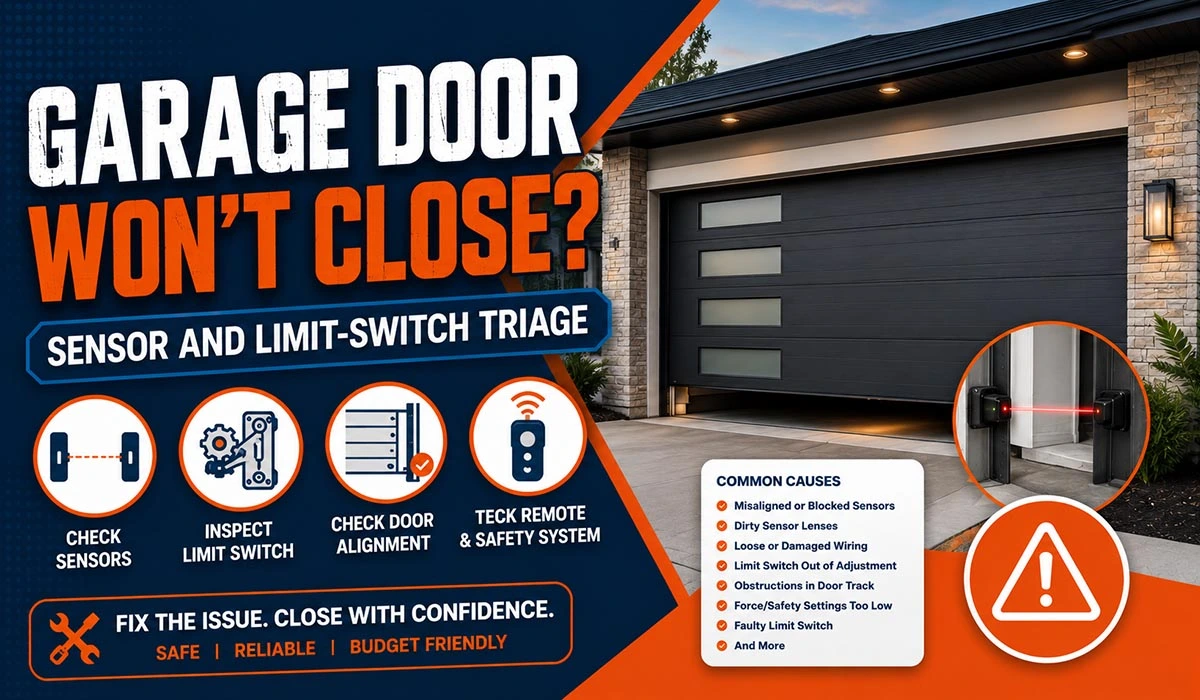

A garage door that will not close is more than an annoyance. It leaves your home open to the cold and to anyone passing by. The good news is that the most common cause is also the easiest to fix, and it is usually the safety sensors rather than anything serious. This guide walks you through the checks in order, from the two-minute sensor fix to the causes that need a technician.
If your garage door won’t close, or closes part way then reverses back up, the safety sensors near the floor are the most likely cause. Check that nothing is blocking them, wipe the lenses, and make sure the two sensors are aligned and both showing a steady light. If the sensors are fine, the limit-switch setting or the opener may be at fault. A door that won’t secure your home overnight is worth a same-day call.
First, understand the safety sensors
Every automatic garage door has two small sensors, one on each side of the door about fifteen centimetres off the floor. They send an invisible beam between them. If anything breaks that beam while the door is closing, the door stops and reverses. This is a safety feature that stops the door closing on a child, a pet or a car. It also means that anything interfering with that beam will stop the door closing, which is exactly why the sensors are the first thing to check.
The sensor checks, in order
- Look for a blockage. A bin, a bike, a box, or even a stray leaf sitting in the beam will stop the door. Clear the area near both sensors.
- Wipe the lenses. Dust, cobwebs, or grime on the little lens will block the beam. A soft cloth is enough.
- Check the lights. Each sensor has a small indicator light. When they are working and aligned, both show a steady light. If one is off or blinking, they are misaligned or one has a fault.
- Realign them. If a sensor got bumped, gently adjust it until both lights are steady. They need to point straight at each other. This fixes a large share of won’t-close problems.
- Check for winter frost. In Edmonton, sensors can fog or frost over in the cold, which blocks the beam just like dirt. Wipe them clear.
The Edmonton winter angle
Sensor trouble spikes in cold weather here. Frost forms on the lenses overnight, condensation builds up, and the door refuses to close in the morning until the sensors clear. If your door only misbehaves on cold mornings, frosted sensors are the prime suspect. Wiping them and, where possible, shielding them from direct drafts usually solves it.
If the sensors are fine
When the sensors are clean, aligned and both showing steady lights but the door still will not close, the cause is elsewhere.
Limit-switch setting
The opener has a setting that tells it how far the door should travel to be fully closed. If that setting has drifted, the opener thinks the door has hit an obstacle before it reaches the floor, so it reverses. Adjusting the limit switch corrects this, though it is fiddly and often worth leaving to a technician.
Force setting
Openers also have a force setting. If it is set too sensitive, the resistance of a stiff or poorly lubricated door reads as an obstruction and the door reverses. This often shows up alongside a door that has become rough or noisy, which the noise diagnosis guide covers.
Opener or track fault
A worn opener, a track problem, or a door that binds part way down can all stop a door closing. If the door hesitates or reverses at the same spot every time, something physical at that point is the likely cause.
When to call
If the sensor checks do not solve it, or you are not comfortable adjusting the limit and force settings, call. A door that will not close is a security and, in an Edmonton winter, a heating problem, so it is not one to leave for the weekend. If it is stuck open overnight, treat it as an emergency.
Frequently asked questions
The door closes if I hold the wall button down. What does that mean?
That is the opener bypassing the sensors because you are holding the button, which confirms the sensors are the problem. Do not rely on holding the button as a fix. Clear and realign the sensors instead.
Both sensor lights are on but it still reverses. Now what?
If the sensors are genuinely aligned and clean, the cause has moved to the limit or force settings, or a physical bind in the door. That is the point to call for a proper diagnosis.
Why does this only happen when it is cold?
Frost and condensation on the sensor lenses in Edmonton winters block the beam just like dirt does. Cold also stiffens the door, which can trip the force setting. Both are common cold-morning causes.
Door won’t close and it’s getting cold inside? Call +1 780-908-0907 for same-day Edmonton service.
