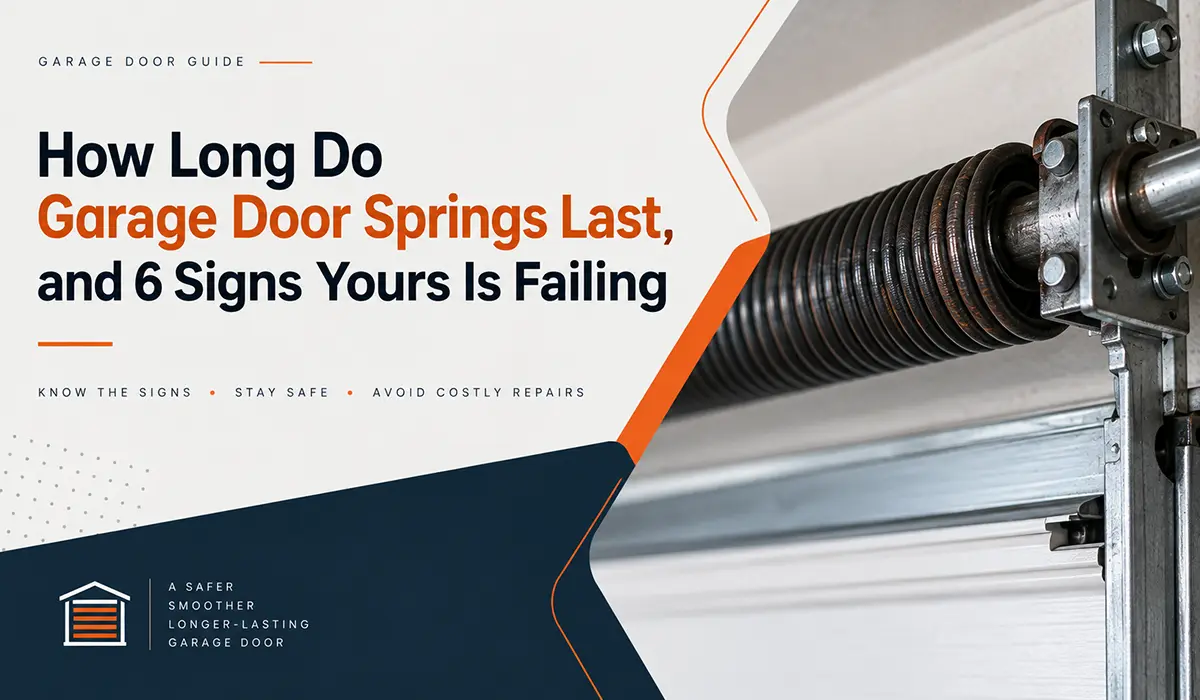

Most garage door springs last between seven and nine years for an average household, but the real answer is measured in cycles, not years. A standard spring is rated for about 10,000 cycles, where one cycle is a single open and close. If you use your door a few times a day, that lands around seven to nine years. If you run it many times a day, you might replace springs in three or four. This guide explains how spring life really works, shows you the six warning signs your spring is on its way out, and tells you what to do before it strands you with a door that will not budge.
Why spring life is measured in cycles, not years
A garage door spring does not wear out by the calendar. It wears out by use. Every time the door goes up and comes back down, the spring winds and unwinds once, and that is one cycle. Springs are rated for a set number of cycles before the metal fatigues and fails, so how long yours lasts depends entirely on how often the door moves.
That is why two identical springs can have very different lifespans. A quiet household that opens the door twice a day will get many years out of a spring. A busy family coming and going, or a home where the garage is the main entrance, burns through cycles far faster. Think of it like the treads on a tire. The tire is not old, it is just well used.
Here is roughly how the standard 10,000 cycle rating translates into years by usage.
| How often you use the door | Cycles per day | Rough spring lifespan |
|---|---|---|
| Light use, twice a day | 2 | Around 14 years |
| Average use, four times a day | 4 | Around 7 years |
| Heavy use, six times a day | 6 | Around 4 to 5 years |
| Very heavy use, eight or more | 8+ | Around 3 to 4 years |
These are estimates, not guarantees. Cold, rust, poor balance, and cheaper springs all pull the real number down, which we cover below.
Do torsion and extension springs last the same?
Not quite. Torsion springs, the ones wound around a shaft above the door, generally last longer and handle more cycles than extension springs, the ones stretched along the side tracks. Torsion springs also fail more safely because the spring stays captured on the shaft. If you are not sure which type you have, our guide on torsion vs extension springs shows you how to tell in about thirty seconds.
You can also buy high cycle springs rated for 20,000 or 30,000 cycles or more. They cost more up front but can double or triple the lifespan, which makes sense for a busy household that would otherwise replace standard springs every few years.
6 signs your garage door spring is failing
Springs sometimes give warning before they break, and sometimes they let go without notice. Watch for these six signs, and if you spot any of them, stop running the opener and have the spring checked.
1. The door feels heavy or will not open
This is the clearest sign. When a spring loses tension or breaks, the opener cannot carry the full weight of the door on its own. The motor hums and strains, but the door barely lifts or does not move at all. A healthy door should feel balanced and lift easily by hand. One that suddenly feels like dead weight has a spring problem.
2. You see a visible gap in the spring
Walk into the garage and look at the spring above the door with the door closed. A working spring is one continuous tight coil. If you see a gap of a few centimetres where the coil has separated into two pieces, the spring has snapped. This is the most direct confirmation there is, and it means the spring needs replacing before the door is used again.
3. You heard a loud bang from the garage
A snapping spring releases its stored energy all at once, and it is loud. People often describe it as a gunshot, a firecracker, or something heavy falling. If you heard a sharp bang from the garage and the door will not open afterward, a broken spring is almost certainly the reason. The sound can happen overnight or when no one is near the door, especially on a cold morning.
4. The door opens partway then stops or sags
A spring that is weakening but not fully broken can lift the door part of the way before the weight overwhelms it. You might also notice the door sagging in the middle or hanging unevenly. This is an early warning that the spring is losing tension, and it is a good moment to book a repair before it fails completely.
5. The door slams shut or closes too fast
When springs weaken, they stop controlling the door’s descent. Instead of lowering smoothly, the door drops fast or closes with a bang. This is not only a sign of spring wear, it is a safety hazard, since a door coming down too fast can damage the door, the opener, or anything under it.
6. Loose cables, jerky movement, or a rusty, stretched spring
Springs and cables work together, so a failing spring often shows up as loose or slack cables and jerky, shaky movement as the door travels. Visible rust on the spring is another red flag, since rust increases friction and eats away at the metal, shortening the spring’s life. A spring that looks stretched out, gapped, or corroded is telling you its days are numbered. If a cable has also gone slack or frayed, you will want garage door cable repair done at the same time.
What shortens spring life
If your springs are failing earlier than the numbers above suggest, one of these is usually why.
Cold. This is the big one in Edmonton. Steel gets more brittle as the temperature drops, which is why springs so often snap on the first hard frost and again in the deepest winter cold. The cold does not just break springs, it stresses them every day of the season.
Rust and no lubrication. A dry, rusty spring fights friction on every cycle and wears out faster. A film of the right lubricant cuts that friction and protects the metal.
Poor door balance. If the door is out of balance, the spring works harder than it should on every single cycle, using up its life faster. Balance is something a technician checks and corrects during a tune up.
Heavy use. More cycles means a shorter lifespan, plain and simple. If your garage is the main way in and out of the house, expect springs to wear faster.
A single spring on a heavy door. Doubling up springs shares the load. A heavy or double door running on one spring wears that spring out faster and leaves you with no backup if it breaks.
What to do the moment a spring fails
Stop using the door. Do not keep pressing the opener button to try to force it, because a straining motor on a broken spring can burn out, and a door with a broken spring can drop or come off balance. If the door is stuck partway and you need your vehicle, wait for a technician rather than trying to muscle it, since an unbalanced door is heavy and unpredictable.
Most importantly, do not try to replace the spring yourself. Both torsion and extension springs hold the full weight of the door under high tension, and replacing one means releasing and re-tensioning parts under load with the correct winding tools. This is a leading cause of injury for homeowners who take it on. Spring replacement belongs with a trained technician. When you need it, book a broken garage door spring replacement in Edmonton.
Should you replace one spring or both?
If your door uses two springs and one breaks, it is usually worth replacing both. They were installed at the same time and have gone through the same number of cycles, so the second one is likely close behind. Replacing the pair together saves you a second service call within months and keeps the door balanced. A technician can walk you through the choice based on the age and condition of your springs.
How to make your springs last longer
You cannot stop a spring from wearing out, but you can slow it down. A yearly tune up is the single best thing you can do. During garage door maintenance, a technician lubricates the spring with cold rated product so it is not fighting stiff grease, checks and corrects the door’s balance so the spring is not overworked, looks for rust and early wear, and tightens the hardware around it. Booking that service in the fall, before the deep cold, is the cheapest way to avoid a broken spring on the worst morning of the year.
When to call Fix in Budget?
A worn or broken spring is a technician job, and a same day one when the door is stuck. Fix in Budget Garage Door Services handles spring replacement, cable repair, and full tune ups across Edmonton, St. Albert, Sherwood Park, Spruce Grove, Leduc, Beaumont, Nisku, and Fort Saskatchewan, backed by a fixed right or it is free guarantee.
Noticing any of the six signs above? Call 780-908-0907 or request a free quote, describe what the door is doing, and we will arrive with the right spring for your door.
Frequently asked questions
How long do garage door springs last?
Most standard garage door springs last about seven to nine years for an average household, but lifespan is measured in cycles rather than years. A standard spring is rated for roughly 10,000 cycles, where one cycle is a single open and close. Frequent use, cold weather, and rust all shorten that lifespan, while high cycle springs and yearly maintenance extend it.
What are the signs of a failing garage door spring?
The main signs are a door that suddenly feels heavy or will not open, a visible gap in the spring coil, a loud bang from the garage, a door that opens partway then stops, a door that closes too fast, and jerky movement with loose cables or a rusty spring. If you notice any of these, stop using the opener and have the spring checked.
Can a garage door still open with a broken spring?
Barely, and you should not try. The opener cannot safely carry the full weight of the door without the spring, so forcing it can burn out the motor and leave the door unbalanced and prone to dropping. Stop using the door and call a technician for a safe replacement.
Should I replace both garage door springs at once?
If your door uses two springs and one breaks, replacing both is usually the smart choice. They have gone through the same number of cycles, so the second spring is likely close to failing too. Replacing the pair keeps the door balanced and saves a second service call.
Why do garage door springs break in winter?
Cold makes steel more brittle, so springs are far more likely to snap on the first hard frost and during the deepest winter cold. That is why breakdowns spike in the cold months in Edmonton. A fall tune up with cold rated lubricant and a balance check helps the spring survive the season.
